

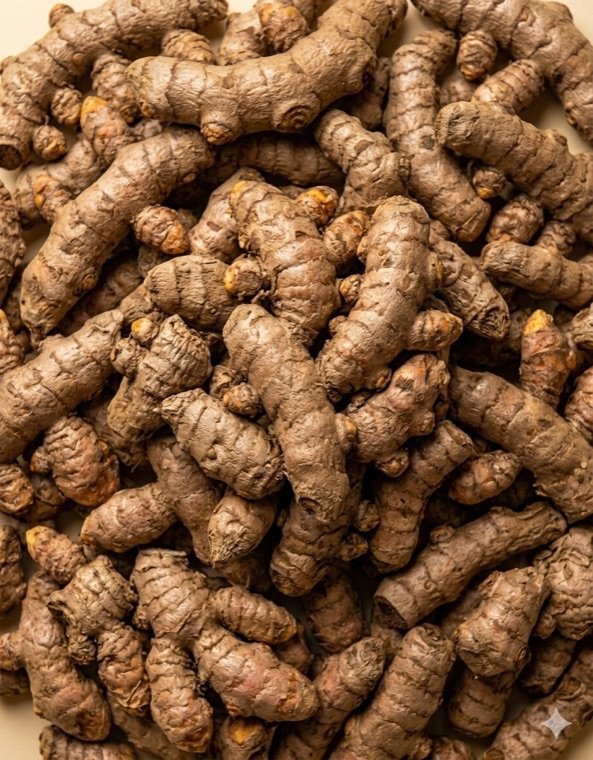
Ingredient Guide
They sound the same, but wild turmeric and kitchen turmeric are two different plants, and for your face, the difference really matters.
If you’ve ever tried a turmeric face pack and walked around with a yellow-stained face, you used the wrong one. Here’s how to choose.
The key differences
- Different plants: kitchen turmeric is Curcuma longa; wild turmeric (kasturi manjal) is Curcuma aromatica.
- Staining: kitchen turmeric stains skin yellow. Wild turmeric is non-staining — the #1 reason it’s used on the face.
- Purpose: kitchen turmeric is culinary/anti-inflammatory; wild turmeric is prized purely for skincare, brightening, spot-fading, oil control.
- Aroma & colour: wild turmeric is lighter, more fragrant and gentler on skin.
Which should you use on your face?
For skincare, glow, tan removal, pigmentation, acne, always choose wild turmeric (kasturi manjal). It gives the benefits of turmeric without the yellow stain, so you can use it as often as 2–3 times a week.
For glow
Wild turmeric + honey, 15 minutes, 2x a week.
For tan & pigmentation
Wild turmeric + curd, applied to affected areas.
For oily/acne skin
Wild turmeric + a pinch of sandalwood + rose water.
Always patch test
Do a small test first, natural doesn’t mean everyone’s skin agrees.
Is kasturi manjal edible?
No. Wild turmeric is used only on skin. Cooking turmeric is the edible one. Do not swap them.
Why is kasturi manjal more expensive?
Lower yield, a smaller growing region, and it is not a bulk commodity crop. If the price matches kitchen haldi, be suspicious of what you are actually buying.
Can I mix the two?
There is no benefit. You get the staining of the cooking one without adding anything the wild one was not already doing.
Does it expire?
The aromatic oils fade over roughly a year. If your powder has stopped smelling musky, it has lost most of what makes it worth using.
How to tell real kasturi manjal from the fake stuff
This is the question worth answering before any recipe, because a good half of what sells as kasturi manjal in India is ordinary Curcuma longa with a South Indian name on the packet.
Three checks, in order of reliability:
- The palm test. Rub a pinch between wet fingers. Real wild turmeric leaves almost no yellow. Cooking turmeric stains immediately and takes a wash to shift.
- The smell. Kasturi means musk. Genuine Curcuma aromatica smells warm and slightly camphor-like. Cooking turmeric smells like food.
- The label. A seller who cannot tell you the botanical name is not sorting the two. If it does not say Curcuma aromatica, assume it is the cheap one.
Why one stains and the other does not
Both plants contain curcuminoids, the yellow pigment family. Cooking turmeric is bred for it, because that colour is the point in food. Wild turmeric carries far less of it and more aromatic volatile oils instead, which is why it was kept for skin and never for the pot.
That single difference is why kasturi manjal became the bridal ubtan herb across South India. You could use it the week of a wedding without turning yellow in the photographs.
Three mistakes people make with both
Frequently asked questions
Does wild turmeric stain skin like normal turmeric?
No, wild turmeric (kasturi manjal) is non-staining, which is exactly why it’s the turmeric used in face packs.
Can I use kitchen turmeric on my face?
You can, but it stains and can be too strong for regular facial use. Wild turmeric is safer and purpose-made for skin.
Is wild turmeric edible?
No, kasturi manjal is for external skincare use only, not for cooking.
