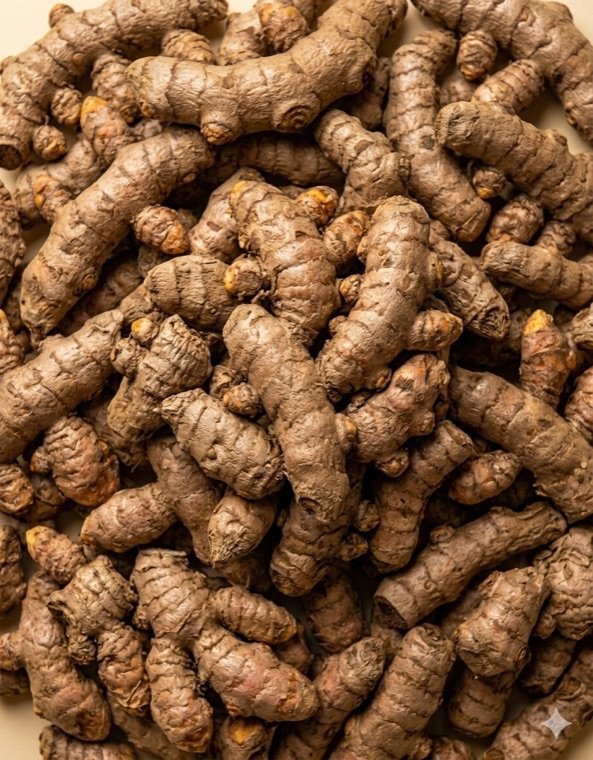
Kasturi manjal is wild turmeric, and it is not the turmeric in your kitchen. Different plant, different purpose, and the one difference that matters most: it does not stain your skin yellow.
This is the full guide. What it is, how to tell the real thing from the cheap substitute, what it genuinely does, what it will not do whatever the internet says, and how to use it for your skin type.
What kasturi manjal actually is
Kasturi manjal is Curcuma aromatica, a relative of the Curcuma longa you cook with. The Tamil name breaks down neatly: kasturi means musk, manjal means turmeric. Musk turmeric, named for how it smells.
You will also see it written as kasthuri manjal, kasturi haldi, wild turmeric, or simply manjal powder. Same plant. The spelling varies because it is a transliteration, not a fixed English word.
Across South India it has been the skin turmeric for centuries, kept separate from the cooking variety and reserved for face packs, bridal preparation and daily washing. It is not edible, which is the other reason it never crossed into the kitchen.
Kasturi manjal vs regular turmeric
This mix-up is the single most common reason people have a bad experience, usually in the form of a yellow face before a function.
2different species
0staining, done right
15minutes maximum
- Species. Kasturi manjal is Curcuma aromatica. Cooking turmeric is Curcuma longa.
- Staining. Cooking turmeric is bred for curcumin, the yellow pigment, because colour is the point in food. Wild turmeric carries far less of it and more aromatic oils instead.
- Edibility. Cooking turmeric is food. Kasturi manjal is for skin only.
- Smell. Wild turmeric is warm and slightly camphor-like. Cooking turmeric smells like a kitchen.
- Price. Lower yield and a smaller growing region mean kasturi manjal costs meaningfully more.
How to tell real kasturi manjal from the fake stuff
A good share of what sells as kasturi manjal in India is ordinary cooking turmeric with a South Indian name on the packet. Three checks, in order of reliability.
1
The palm test
Rub a pinch between wet fingers. Real wild turmeric leaves almost no yellow. Cooking turmeric stains straight away and takes a wash to shift.
2
The smell test
Kasturi means musk for a reason. Genuine Curcuma aromatica smells warm and resinous. If it smells like sambar, it is the wrong plant.
3
The label test
If the seller cannot tell you the botanical name, they are not sorting the two. It should say Curcuma aromatica.
4
The price test
If a pouch costs the same as kitchen haldi, something is wrong. The economics do not work.
What kasturi manjal genuinely does
The actives are curcuminoids and aromatic volatile oils. Curcumin and its relatives have reasonably documented anti-inflammatory and antimicrobial activity, which the US National Center for Complementary and Integrative Health summarises fairly.
The honest caveat is that most of that research uses concentrated curcumin extracts, not a spoon of powder mixed with curd. The direction of evidence is encouraging. The strength of it is routinely overstated.
What that means in practice:
- Redness and irritation. The best supported claim. Reactive skin tends to calm.
- Breakout-prone skin. Antibacterial action against the organisms involved in acne is plausible. Useful as a habit, not a treatment.
- Tan and uneven tone. The reason most people buy it. It nudges pigment to fade gradually rather than bleaching anything.
- Bridal preparation. The traditional use, and the one it is genuinely best at: a calm, even complexion built over weeks.
What it will not do
Worth being direct, because a lot of search traffic arrives looking for something this plant cannot deliver.
Kasturi manjal will not lighten your natural skin tone. It fades tan and evens out patchiness, which returns you to your own baseline colour. It does not take you past it, and anything marketed as skin whitening is a different and far more troubling category of product.
It will not clear cystic acne, which needs a dermatologist. It will not remove deep melasma either. For pigmentation that has sat there for years, the treatments with real evidence are the ones the American Academy of Dermatology lists, and a face pack is not among them.
Kasturi manjal is a maintenance ingredient, not a correction tool. Used twice a week for six weeks it makes skin calmer and more even. It is not going to change your face in a fortnight, and any seller promising that is not being straight with you.
How to use it, by skin type
A pinch is genuinely enough. Half a teaspoon covers a whole face, and a 100g pouch used properly lasts most people around six months.
Tan and dullness. Half a teaspoon with one tablespoon of curd. Fifteen minutes. The lactic acid in curd exfoliates gently while the turmeric handles inflammation.
Oily or breakout-prone. Half a teaspoon with enough rose water to make a thin paste. Ten minutes only, and do not let it dry to cracking point.
Dry or mature skin. Half a teaspoon with a teaspoon of raw honey and a few drops of milk. Honey holds water in the skin and offsets the tightening.
Bridal, six weeks out. Twice weekly with curd, stopping all new products in the final ten days. The worst reactions happen when someone adds something new in the last week hoping to speed things up.
The nalangu tradition
If you grew up in a Tamil household you have seen this. Nalangu is the pre-wedding ceremony where turmeric paste is applied to the bride and groom, and kasturi manjal is what gets used rather than cooking turmeric, precisely because nobody wants a yellow bride in the photographs.
The practical wisdom in it holds up. Six weeks of gentle, consistent, anti-inflammatory care beats anything dramatic attempted in the final week.
Storage and shelf life
The aromatic oils fade over roughly a year. Keep it in an airtight jar away from light and heat, and use a dry spoon every time, because moisture in the jar is what spoils a powder.
If your powder has stopped smelling musky, it has lost most of what makes it worth using. That smell is the active fraction, not a perfume.
Who should be careful
Patch test first. Inner arm, wait a full day. Turmeric allergy is uncommon but real, and discovering it on your face before a wedding is a bad way to learn.
Skip it mid-course on retinoids or acids. Adding an active while your barrier is already busy turns mild irritation into something that takes weeks to settle.
Never leave it on overnight. Fifteen minutes. Longer dries the skin and gives you nothing extra.
Common questions
Is kasturi manjal the same as kasthuri manjal?
Yes. Both spellings refer to the same plant, Curcuma aromatica. It is a transliteration from Tamil, so spelling varies.
Can I eat kasturi manjal?
No. Wild turmeric is for external use only. Cooking turmeric is the edible one.
Will it make my face yellow?
Real kasturi manjal does not stain. If yours does, you have been sold cooking turmeric under a South Indian name.
Does it whiten skin?
No, and it should not be sold that way. It fades tan and evens out patchiness, returning you to your natural tone rather than changing it.
How often should I use it?
Twice a week, fifteen minutes. Daily use of any powder pack compromises the skin barrier.
How long before I see results?
Reduced redness in about two weeks. Visible evening of tone in four to six weeks of consistent use.
Can I use it on my body?
Yes. It is traditionally used for the whole body in ubtan and nalangu preparations, not just the face.
Is it safe during pregnancy?
Topical use in normal amounts is generally considered fine, but ask your doctor rather than the internet.
Why is it more expensive than regular turmeric?
Lower yield, a smaller growing region, and it is not a bulk commodity crop. If the price matches kitchen haldi, be suspicious.
Read next